Introduction
Inspired by the human brain's architecture, neuromorphic devices and sensing technologies can offer enhanced efficiency and real-time processing. This post examines neuromorphic principles as they apply to biosensors, with the aim of enhancing sensitivity, energy efficiency, and data interpretation in complex biological environments. Neuromorphic computing has changed significantly since Carver Mead coined the term at CalTech [6]. The term was used to describe electronic systems that perform computation with signals resembling those found within the nervous system. It is now commonly used to describe a broader range of technologies that take inspiration from biological signal processing and/or memory [6].
The McCulloch-Pitts Neuron
The McCulloch-Pitts neuron model and Hebbian learning were the foundations for developing neuromorphic computing [2, 3]. The McCulloch-Pitts (MCP) neuron is a simple artificial neuron that functions at discrete time steps. Multiple inputs (x1, x2, x3, ..., xn) of the neuron undergo inhibition or facilitation resulting in a single output (y). Both input and output signals are binary elements of either 0 or 1. The MCP neuron has a threshold (g) determined to be a positive integer.
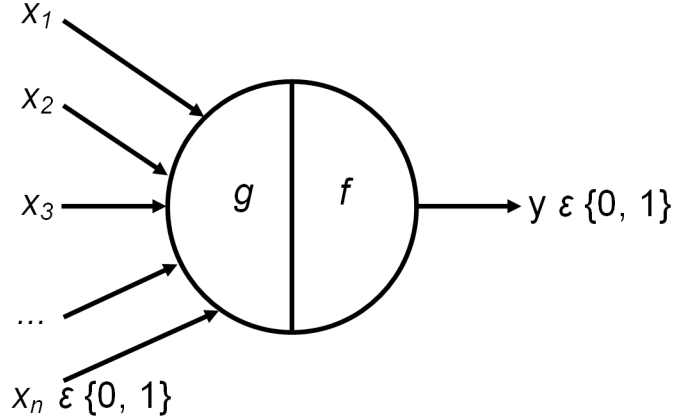
The operation of the MCP neuron is defined as:
At time t+1, a neuron fires (y(t+1) = 1) provided the input cumulative firing counts meet a threshold (g). If there are insufficient inputs and/or inhibitory inputs and the threshold is not reached, the neuron does not fire (y(t+1) = 0). The outputs can connect to any number of neurons and self-loops are possible. However, no output can connect more than once for a single neuron, allowing for more stable behaviour, even in self-loop scenarios.
The MCP neuron model was an attempt to formally model the behaviour of biological neurons through mathematical and logical concepts. Notably, McCulloch and Pitts demonstrated within their 1943 paper that networks composed of these simple neurons could theoretically compute any computable function [2]. The model does suffer limitations, including oversimplification of the intricate behaviours of biological neurons, and the assumption of a deterministic framework rather than the probabilistic and noisy one characteristic of real neurons [35]. Its core weighted sums and thresholding principles nonetheless remain fundamental to modern deep-learning architectures and neuromorphic systems.
Hebbian Learning
Hebbian learning, summarised as "cells that fire together, wire together", is key to understanding synaptic plasticity and adaptive learning in neural networks. It refers to the simultaneous activation of two neurons strengthening their connection, a foundational idea for synaptic plasticity. Dr. Hebb published this in The Organization of Behavior in 1949 [3].
This concept informs learning algorithms in artificial neural networks. An extension, spike-rate-dependent plasticity (SRDP), considers the timing of neuronal firings [3]. Observing SRDP deepens understanding of synaptic changes, reinforcing Hebbian theory's relevance in both biological and artificial systems [33, 35].
Carver Mead and the Origins of Neuromorphic Engineering
Carver Mead's work at CalTech in the 1980s, particularly in Analog VLSI and Neural Systems, introduced the term "neuromorphic processors." His research focused on designing analog circuits that emulate the computational principles of biological neural systems, pioneering the first neuromorphic systems that used sub-threshold analog circuits to replicate neuronal dynamics [6]. Working with Mead, Misha Mahowald developed a silicon retina, further demonstrating the effectiveness of neuromorphic systems in sensory processing and real-time adaptation [8]. Mead's research highlighted the parallels between sub-threshold transistor physics and biological neuron behaviour, establishing neuromorphic engineering as a new research field [6, 9, 10].
Large-Scale Neuromorphic Learning Systems
The principles developed by neuromorphic pioneers have led to large-scale hardware platforms. The Neurogrid project at Stanford University, led by Kwabena Boahen, produced a system capable of simulating millions of neurons in real-time using analog circuits [11, 12]. IBM's SyNAPSE program (2008) led to chips emulating the brain's synaptic plasticity and energy efficiency [13]. The TrueNorth chip (2014) featured one million programmable neurons and 256 million synapses at only 70 mW [13, 14].
The SpiNNaker project began in the early 2000s to create a massively parallel computing platform for real-time spiking neural network simulation [15]. The European Human Brain Project aimed to create detailed brain models and develop neuromorphic hardware, facilitating collaboration among neuroscientists and engineers [16, 18].
Intel's Loihi chip demonstrated real-time learning and energy-efficient AI applications [19, 20]. The Knowm initiative explored memristor-based neuromorphic systems, with anti-Hebbian and Hebbian computing introducing innovative perspectives on synaptic plasticity [21-23].
The University of Heidelberg's BrainScaleS project built analog neuromorphic systems mimicking neural dynamics and plasticity [24, 25]. HP Labs advanced neuromorphic computing through memristor research, laying the groundwork for in-memory computing and energy-efficient neuromorphic architectures [26].
The Institute of Neuroinformatics (INI), established in 1995 at the University of Zurich and ETH Zurich, contributed the neuromorphic vision sensor, a silicon cochlea, and medium-scale processors including the ROLLS and cxQuad chips [27, 28].
Spiking Neural Networks and Spike-Rate-Dependent Plasticity
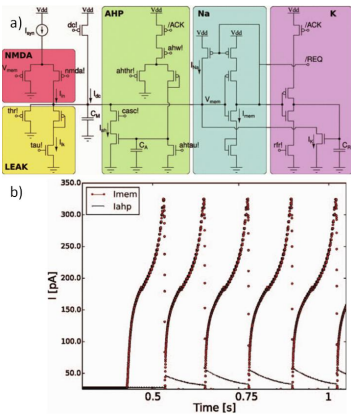
Spiking Neural Networks (SNNs) use the timing and frequency of neural spikes for information encoding, while Spike-Rate-Dependent Plasticity (SRDP) enables adaptive learning [33]. SNNs emulate biological neural networks and leverage neuromorphic hardware due to their lower power consumption compared to traditional networks, which often face the von Neumann bottleneck [12, 15, 32]. They communicate through discrete electrical spikes, aligning with the principles of biological sparsity and temporal coding [35, 36].
A key learning mechanism in SNNs is SRDP, which adjusts synaptic strength based on the timing of neuronal spikes following Hebbian principles. A presynaptic spike preceding a postsynaptic spike enhances synaptic strength (long-term potentiation), while the opposite order results in a decrease (long-term depression). SRDP can be modelled using pair-based and triplet-based approaches [37-39].
Foundational models like those proposed by Hodgkin and Huxley (1952) and the simplified Leaky Integrate-and-Fire (LIF) model illustrate how neurons accumulate input until a spike is triggered [40, 41]. The LIF model represents a neuron's membrane potential V(t) as:
Learning in SNNs is fundamentally shaped by Hebbian principles and mechanisms such as spike-timing-dependent plasticity (STDP), which allows unsupervised learning. Recent advances have integrated supervised techniques using surrogate gradients. Training SNNs is complicated by the non-differentiable nature of spike operations, which results in SNNs being trained less frequently than their artificial network counterparts [42, 43]. Training methods can be broadly classified into supervised learning (gradient descent and spike backpropagation) and unsupervised learning (local synaptic rules and SRDP) [43].
References
- [1] A. Calimera, E. Macii, and M. Poncino, "The human brain project and neuromorphic computing," Functional Neurology, vol. 28, no. 3, p. 191, 2013.
- [2] W. S. McCulloch and W. Pitts, "A logical calculus of the ideas immanent in nervous activity," The Bulletin of Mathematical Biophysics, vol. 5, pp. 115-133, 1943.
- [3] D. O. Hebb, The Organisation of Behavior. New York, NY: Wiley, 1949.
- [4] F. Rosenblatt, "The perceptron: a probabilistic model for information storage and organization in the brain," Psychological Review, vol. 65, no. 6, p. 386, 1958.
- [5] M. Minsky and S. Papert, "An introduction to computational geometry," Cambridge, MA: MIT, vol. 479, no. 480, p. 104, 1969.
- [6] C. Mead, "Neuromorphic electronic systems," Proceedings of the IEEE, vol. 78, no. 10, pp. 1629-1636, 1990.
- [7] C. Mead and M. Ismail (Eds.), Analog VLSI Implementation of Neural Systems, vol. 80. Springer Science & Business Media, 2012.
- [8] M. Mahowald, "VLSI analogs of neuronal visual processing: a synthesis of form and function," Doctoral dissertation, California Institute of Technology, 1992.
- [9] D. Kudithipudi et al., "Neuromorphic computing at scale," Nature, vol. 637, no. 8047, pp. 801-812, 2025.
- [10] T. A. Molter, "A Brief History of Neuromorphic Computing."
- [11] K. Boahen, "Neurogrid: emulating a million neurons in the cortex," in Conf. Proc. IEEE Eng. Med. Biol. Soc., vol. 6702, Aug. 2006.
- [12] B. V. Benjamin et al., "Neurogrid: A mixed-analog-digital multichip system for large-scale neural simulations," Proceedings of the IEEE, vol. 102, no. 5, pp. 699-716, 2014.
- [13] P. A. Merolla et al., "A million spiking-neuron integrated circuit with a scalable communication network and interface," Science, vol. 345, no. 6197, pp. 668-673, 2014.
- [14] F. Akopyan et al., "Truenorth: Design and tool flow of a 65 mw 1 million neuron programmable neurosynaptic chip," IEEE Transactions on Computer-Aided Design of Integrated Circuits and Systems, vol. 34, no. 10, pp. 1537-1557, 2015.
- [15] S. B. Furber, F. Galluppi, S. Temple, and L. A. Plana, "The SpiNNaker project," Proceedings of the IEEE, vol. 102, no. 5, pp. 652-665, 2014.
- [16] H. Markram et al., "Introducing the human brain project," Procedia Computer Science, vol. 7, pp. 39-42, 2011.
- [17] J. Schemmel et al., "A wafer-scale neuromorphic hardware system for large-scale neural modeling," in Proc. IEEE ISCAS, 2010, pp. 1947-1950.
- [18] H. Markram, "The human brain project," Scientific American, vol. 306, no. 6, pp. 50-55, 2012.
- [19] M. Davies et al., "Loihi: A neuromorphic manycore processor with on-chip learning," IEEE Micro, vol. 38, no. 1, pp. 82-99, 2018.
- [20] M. Davies et al., "Advancing neuromorphic computing with Loihi: A survey of results and outlook," Proceedings of the IEEE, vol. 109, no. 5, pp. 911-934, 2021.
- [21] R. Kozma, R. E. Pino, and G. E. Pazienza (Eds.), Advances in Neuromorphic Memristor Science and Applications, vol. 4. Springer Science & Business Media, 2012.
- [22] C. Zamarreño-Ramos et al., "On spike-timing-dependent-plasticity, memristive devices, and building a self-learning visual cortex," Frontiers in Neuroscience, vol. 5, p. 26, 2011.
- [23] G. Indiveri and S.-C. Liu, "Memory and information processing in neuromorphic systems," Proceedings of the IEEE, vol. 103, no. 8, pp. 1379-1397, 2015.
- [24] J. Schemmel et al., "A wafer-scale neuromorphic hardware system for large-scale neural modeling," in Proc. IEEE ISCAS, 2010, pp. 1947-1950.
- [25] C. Pehle et al., "The BrainScaleS-2 accelerated neuromorphic system with hybrid plasticity," Frontiers in Neuroscience, vol. 16, p. 795876, 2022.
- [26] D. B. Strukov, G. S. Snider, D. R. Stewart, and R. S. Williams, "The missing memristor found," Nature, vol. 453, no. 7191, pp. 80-83, 2008.
- [27] R. J. Douglas and K. A. Martin, "Neuronal circuits of the neocortex," Annual Review of Neuroscience, vol. 27, no. 1, pp. 419-451, 2004.
- [28] G. Indiveri et al., "Neuromorphic silicon neuron circuits," Frontiers in Neuroscience, vol. 5, p. 73, 2011.
- [29] G. Indiveri, F. Corradi, and N. Qiao, "Neuromorphic architectures for spiking deep neural networks," in Proc. IEEE IEDM, 2015, pp. 4-2.
- [30] D. S. Modha et al., "Cognitive computing," Communications of the ACM, vol. 54, no. 8, pp. 62-71, 2011.
- [31] W. Zhang et al., "The development of general-purpose brain-inspired computing," Nature Electronics, pp. 1-12, 2024.
- [32] K. Roy, A. Jaiswal, and P. Panda, "Towards spike-based machine intelligence with neuromorphic computing," Nature, vol. 575, no. 7784, pp. 607-617, 2019.
- [33] W. Maass, "Networks of spiking neurons: the third generation of neural network models," Neural Networks, vol. 10, no. 9, pp. 1659-1671, 1997.
- [34] P. A. Merolla et al., "A million spiking-neuron integrated circuit with a scalable communication network and interface," Science, vol. 345, no. 6197, pp. 668-673, 2014.
- [35] W. Gerstner, W. M. Kistler, R. Naud, and L. Paninski, Neuronal Dynamics: From Single Neurons to Networks and Models of Cognition. Cambridge University Press, 2014.
- [36] S. Thorpe, A. Delorme, and R. Van Rullen, "Spike-based strategies for rapid processing," Neural Networks, vol. 14, no. 6-7, pp. 715-725, 2001.
- [37] G. Q. Bi and M. M. Poo, "Synaptic modifications in cultured hippocampal neurons: Dependence on spike timing, synaptic strength, and postsynaptic cell type," Journal of Neuroscience, vol. 18, no. 24, pp. 10464-10472, 1998.
- [38] Y. Park, W. Choi, and S. B. Paik, "Symmetry of learning rate in synaptic plasticity modulates formation of flexible and stable memories," Scientific Reports, vol. 7, no. 1, p. 5671, 2017.
- [39] S. Song, K. D. Miller, and L. F. Abbott, "Competitive Hebbian learning through spike-timing-dependent synaptic plasticity," Nature Neuroscience, vol. 3, no. 9, pp. 919-926, 2000.
- [40] A. L. Hodgkin and A. F. Huxley, "A quantitative description of membrane current and its application to conduction and excitation in nerve," The Journal of Physiology, vol. 117, no. 4, p. 500, 1952.
- [41] D. Tal and E. L. Schwartz, "Computing with the leaky integrate-and-fire neuron: logarithmic computation and multiplication," Neural Computation, vol. 9, no. 2, pp. 305-318, 1997.
- [42] A. Siddique, M. I. Vai, and S. H. Pun, "A low cost neuromorphic learning engine based on a high performance supervised SNN learning algorithm," Scientific Reports, vol. 13, no. 1, p. 6280, 2023.
- [43] C. Zhou et al., "Direct training high-performance deep spiking neural networks: a review of theories and methods," Frontiers in Neuroscience, vol. 18, p. 1383844, 2024.